Lull: from installs
to protected days
Why half of new users never let Lull work, what I built to fix it, and how Lull grows and earns from here.
Martin GregorNovember 2026Prototype, deck and research board
What we optimise for, and for whom.
Goal: daily active users
Assumption: the goal is daily active users. A blocker does its job when it is not opened, so I define active as protected:
DAU = people Lull protected that day
they tried to open a blocked app and the block held. Averaged over 7 days; app opens are tracked next to it.
- Counting only app opens would miss 23% of the days Lull did its job: it blocked, and the user never opened Lull.
- The design reduces opens on purpose: no timers, a held block closes the app. A blocker that works should need opening less.
Audience: iPhone users losing hours a day to their phone
68% say 3-7 hours a day. 48% US, 16% UK. Two main jobs, one app:
| Goal picked (today's wording) | Share | The job |
|---|---|---|
| Less social media | 33% | An all-day fight with the feed |
| Focus at work | 33% | Protect a work window |
| Better sleep | 22% | Protect the evening |
| Time with family | 12% | Protect set moments |
The market: 45% of US adults tried to cut back on their phone last year, and 3 in 4 did not fully succeed (Pew, 2026). Appendix E.
Onboarding already asks the goal. I use the answer to build the whole plan, not to build two products.
DAU = installs x activation x retention. Installs are fixed, so the levers are getting people to a first held block, then keeping them protected.
Out of every 100 installs
1. Activation fills the pool
Two in three installs never get a single held block. Without one, almost nobody is protected in week 2 (1.5%).
2. Retention keeps it full
Of those who activate, half are still protected in week 2, and the pool keeps draining after that.
Problem 1: two in three new users never have Lull block anything for them. Most are lost before Lull is even allowed to.
Too long before the ask
6 screens come before Apple's Screen Time ask, and 5-8% of people quit on each one.
"No" is final
After a "no", Lull never asks again by itself: you must tap "Try again" or find it in Settings. Only 112 people did, and 59% of them said yes. So only 3% of everyone who says no ever allows it.
Weekend setups wait
Most first plans block work hours, Monday to Friday. Set one up Friday to Sunday and nothing is blocked until Monday: 38% get a held block in 24h, vs 71% on a weekday.
Fix 1: get more people to allow Screen Time and reach their first held block on day 1.
| Where people drop today | What the prototype changes |
|---|---|
| 25% quit before the Screen Time ask | Fewer steps: 3 screens before the ask instead of 6 (a goal, a plan, a promise) |
| 29% tap Don't Allow | A reason to say yes: they commit to their plan first, then a guided ask shows exactly what to tap |
| Only 3% of them say yes later | Lull asks again itself. A/B test: an easy "Not now" vs asking until allowed |
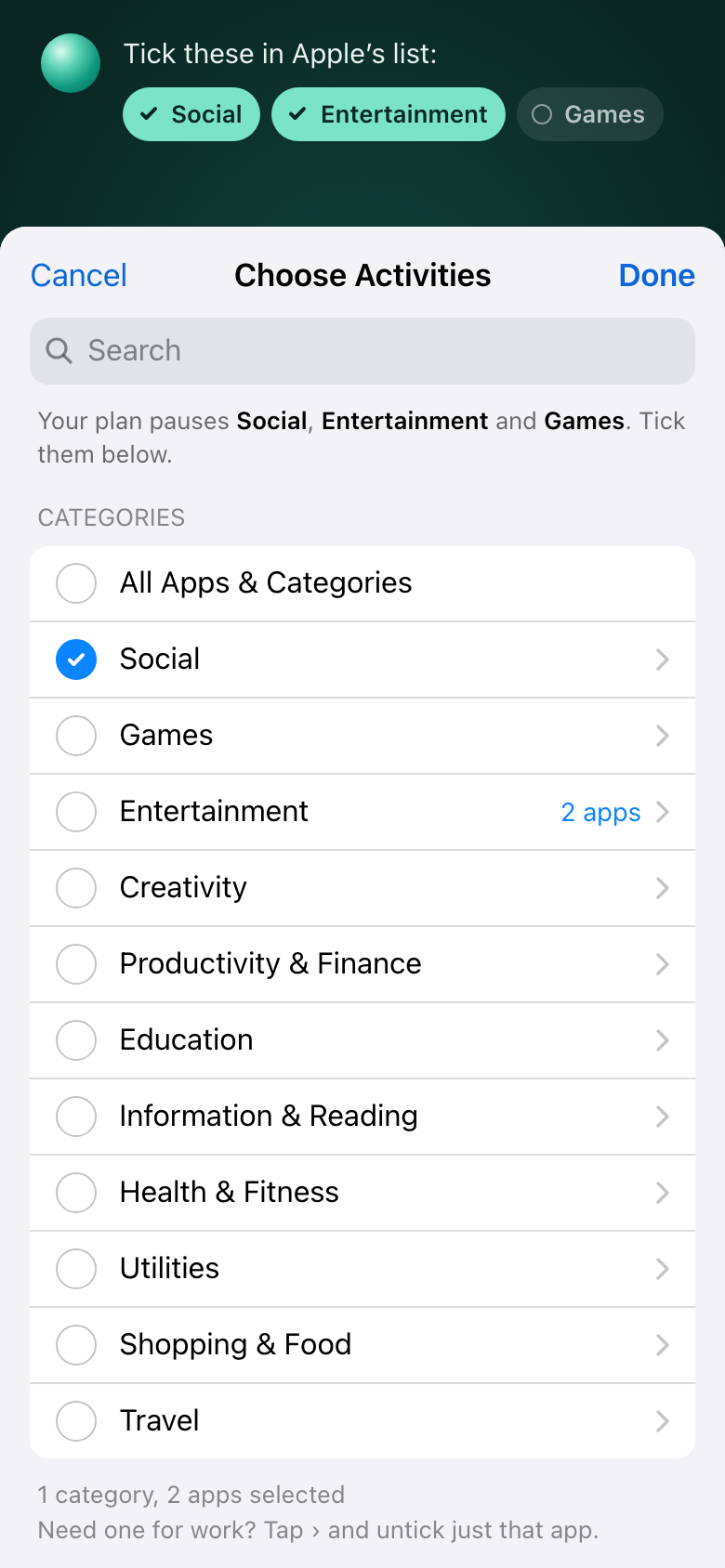
| 8% quit while picking apps | The plan says what to block: a checklist shows which categories to tick in Apple's list |
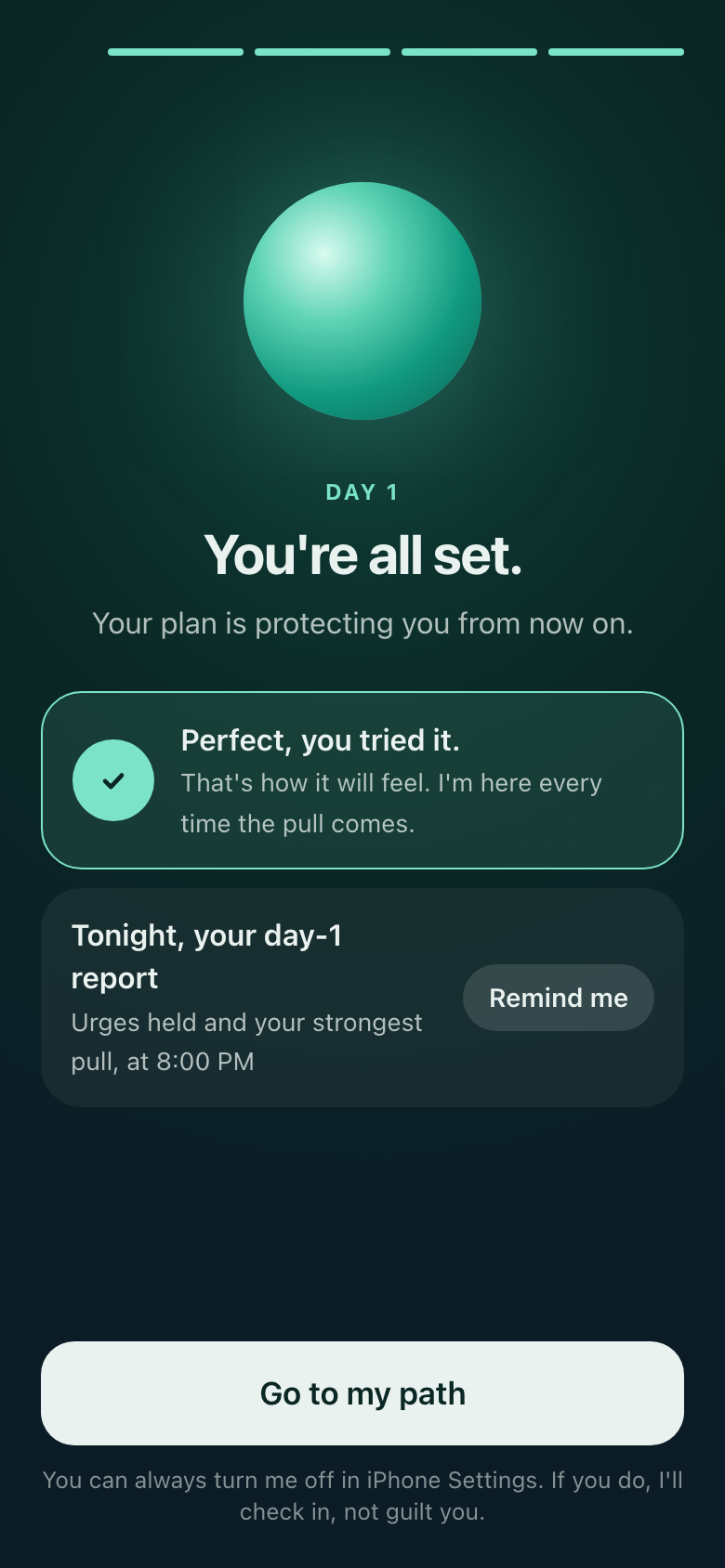
| Weekend setups wait until Monday | 2 protected hours right away, plus a practice block (it doesn't count toward the metric) |
What Fix 1 could add, and how we would prove it
If 42% instead of 33% get a held block on day 1, 8-24% more people are protected in week 2. The A/B test needs about 6 weeks.
From the iPhone home screen to a live plan in about a minute.
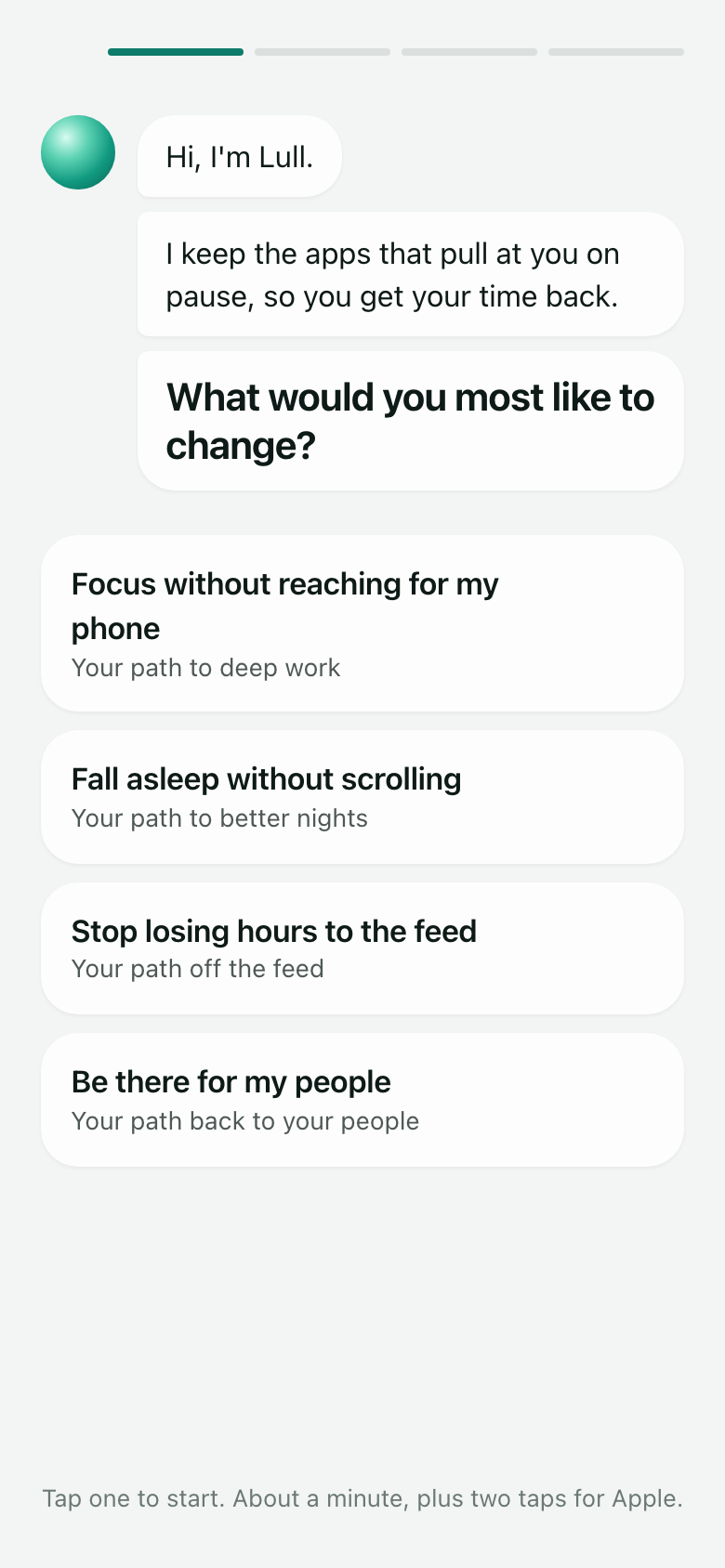
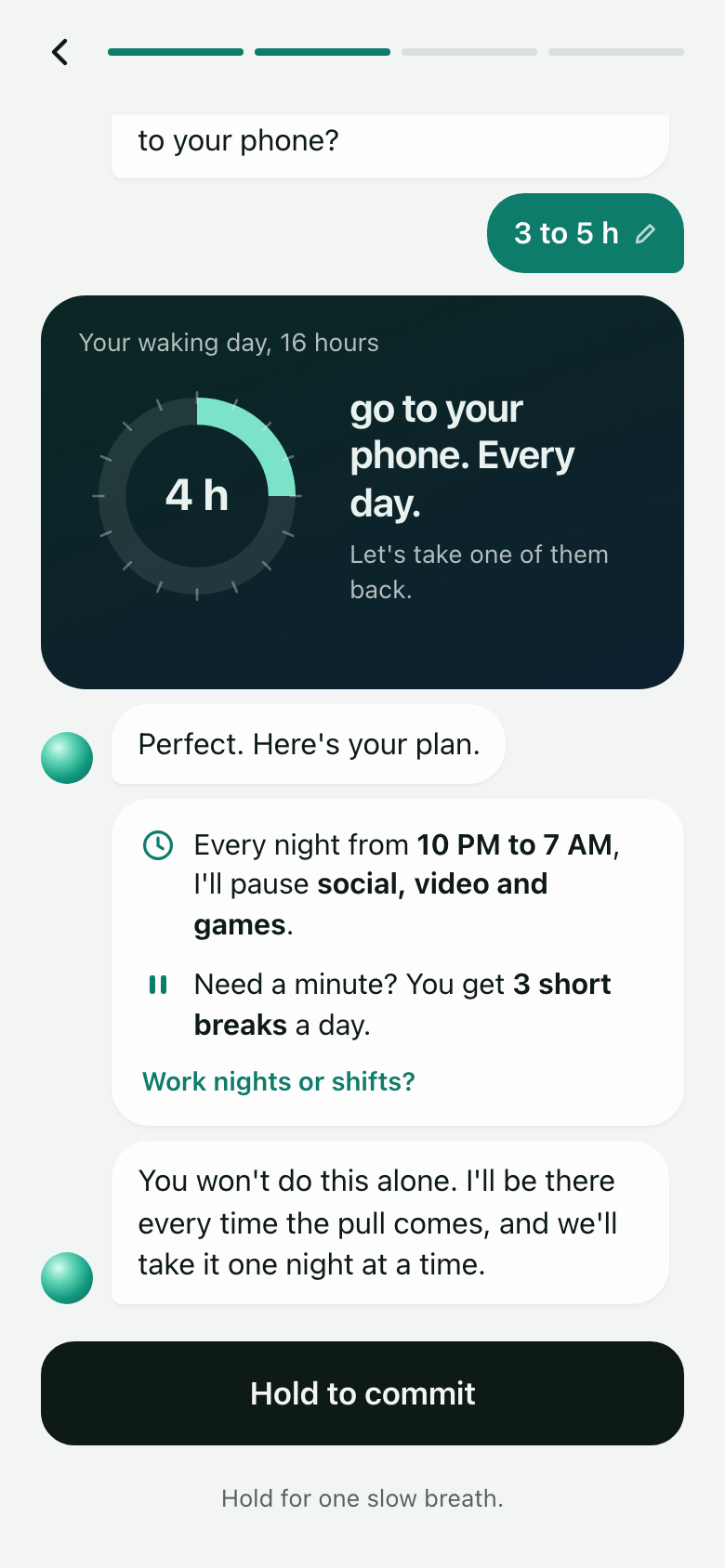
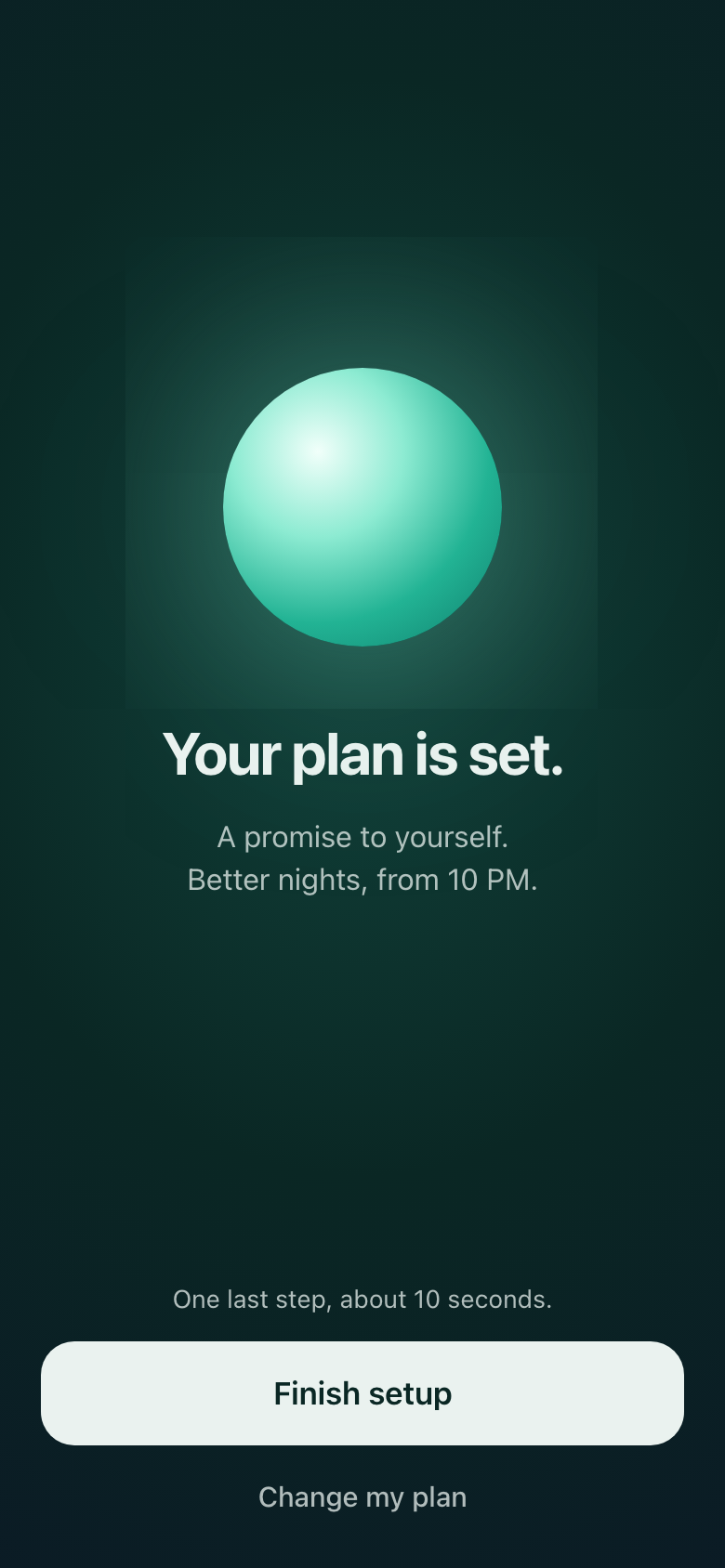
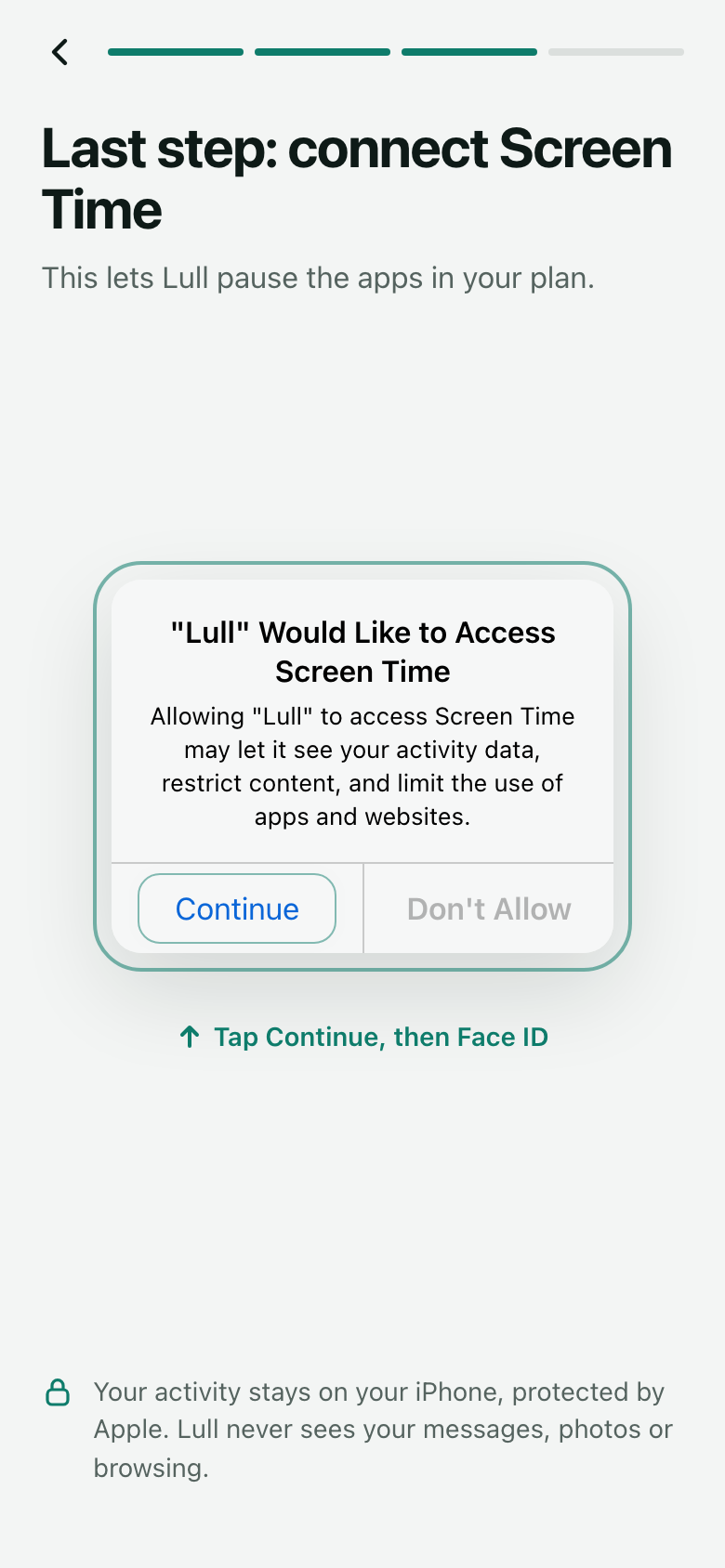
Problem 2: after activation, protection fades. Social and sleep users fade fastest.
Who fades fastest: week-2 protected, by goal
| Goal | Week 2 |
|---|---|
| Less social media | 41% (n=121) |
| Better sleep | 44% (n=82) |
| Focus at work | 63% (n=81) |
| Time with family | 65% (n=40) |
Where people drop off: of 137 users who went quiet, 85 did so in the first 3 days; 20% turn all blocking off by day 14; 19% of block screens end with a 5-minute break.
A reason to come back every day, and a block screen that suggests something to do instead.
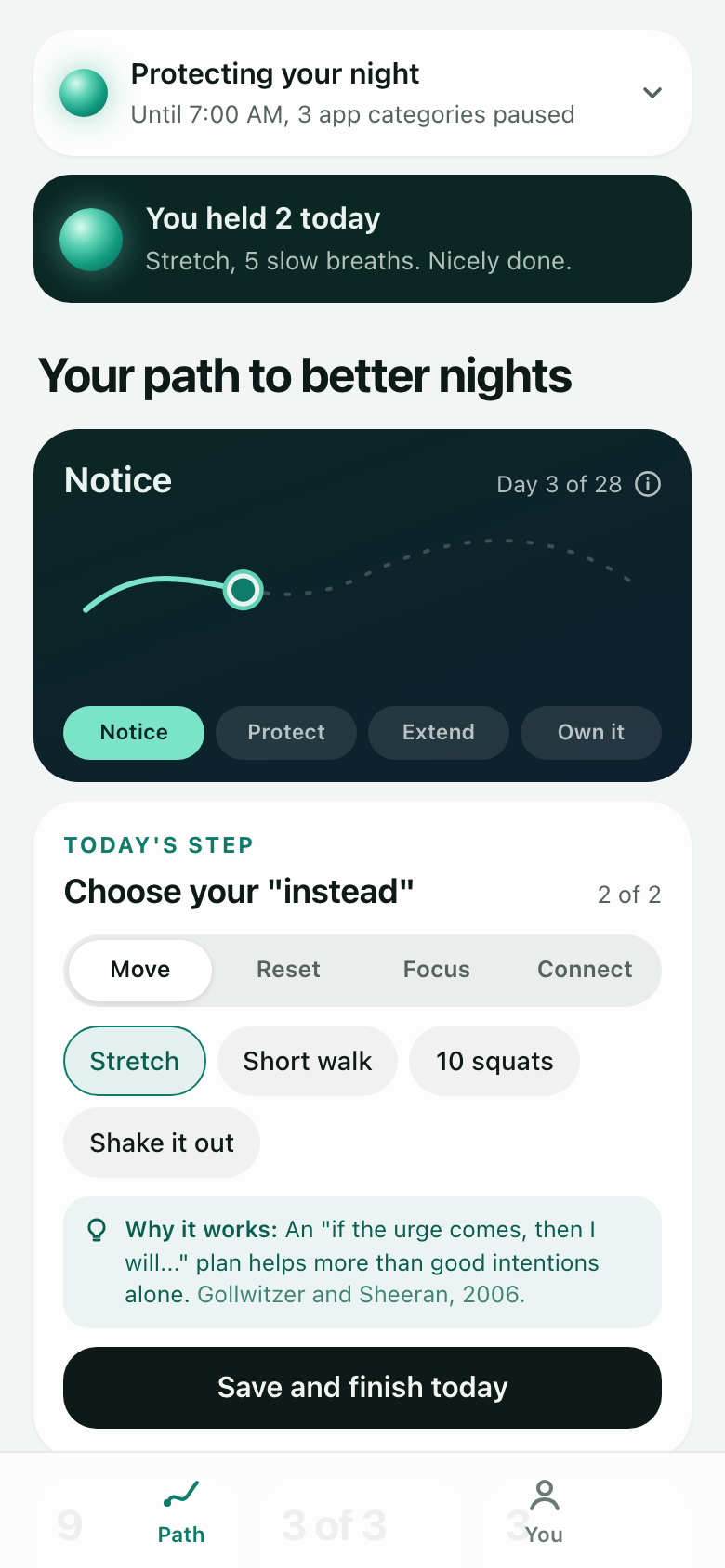
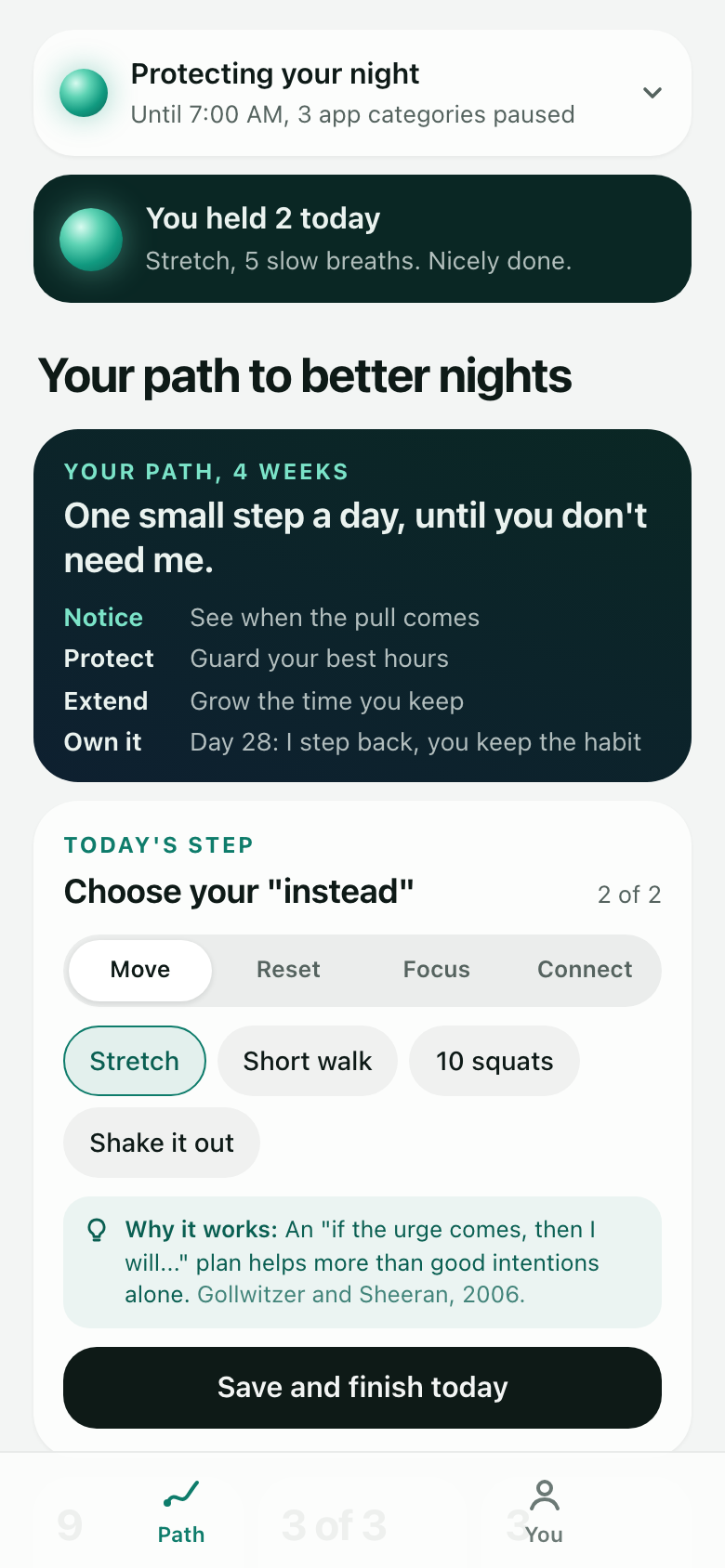
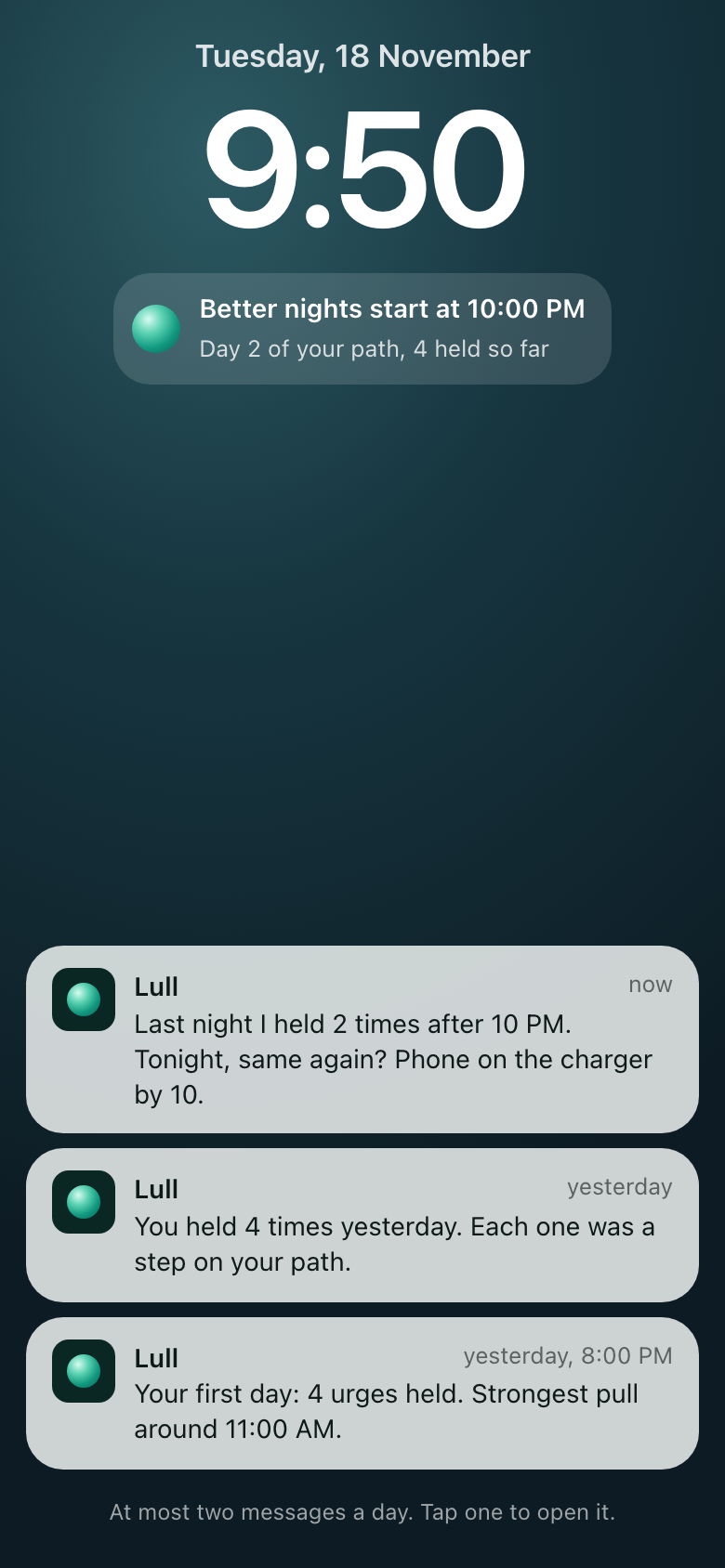
2. The path: four weeks, one small step a day
27% of activated users go quiet by day 3. The path gives one small step and one sourced fact a day.
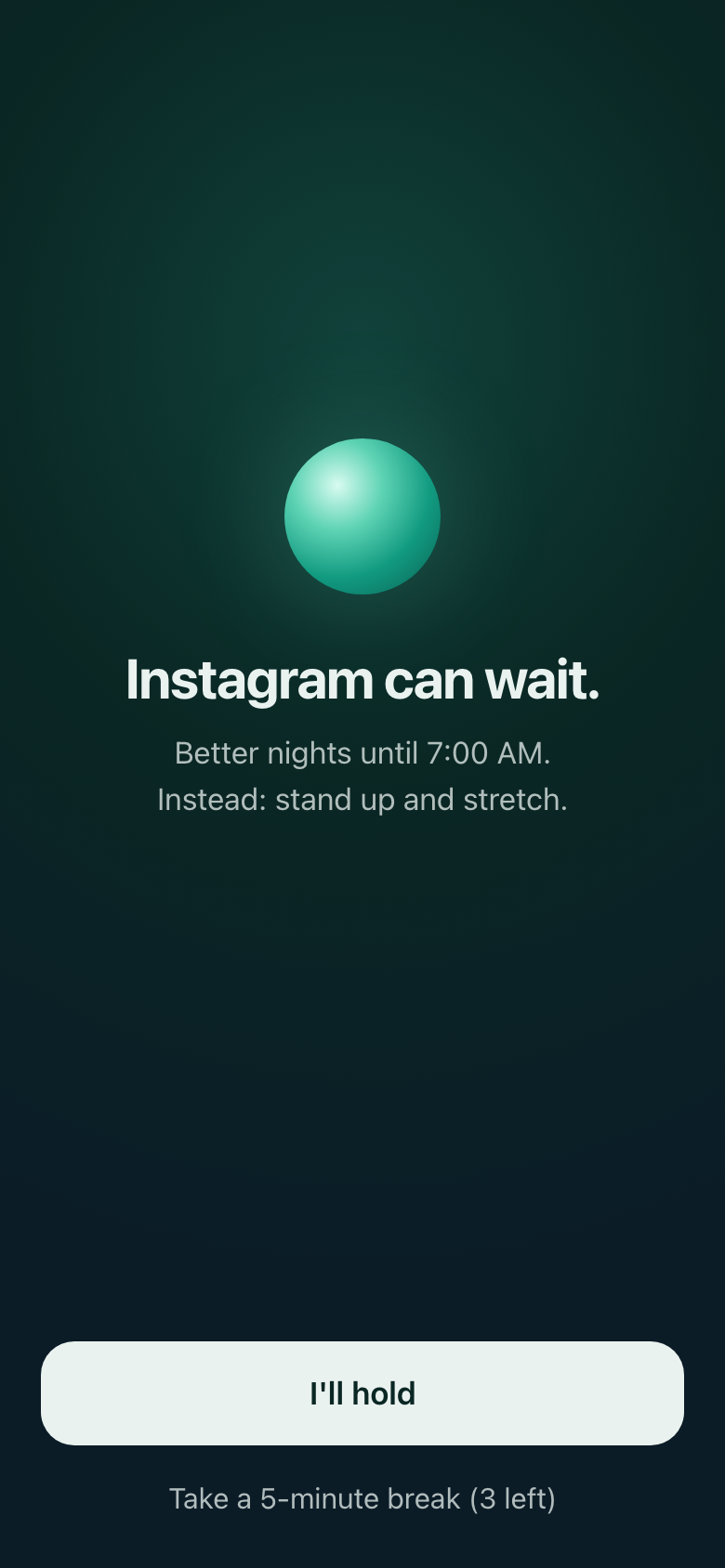
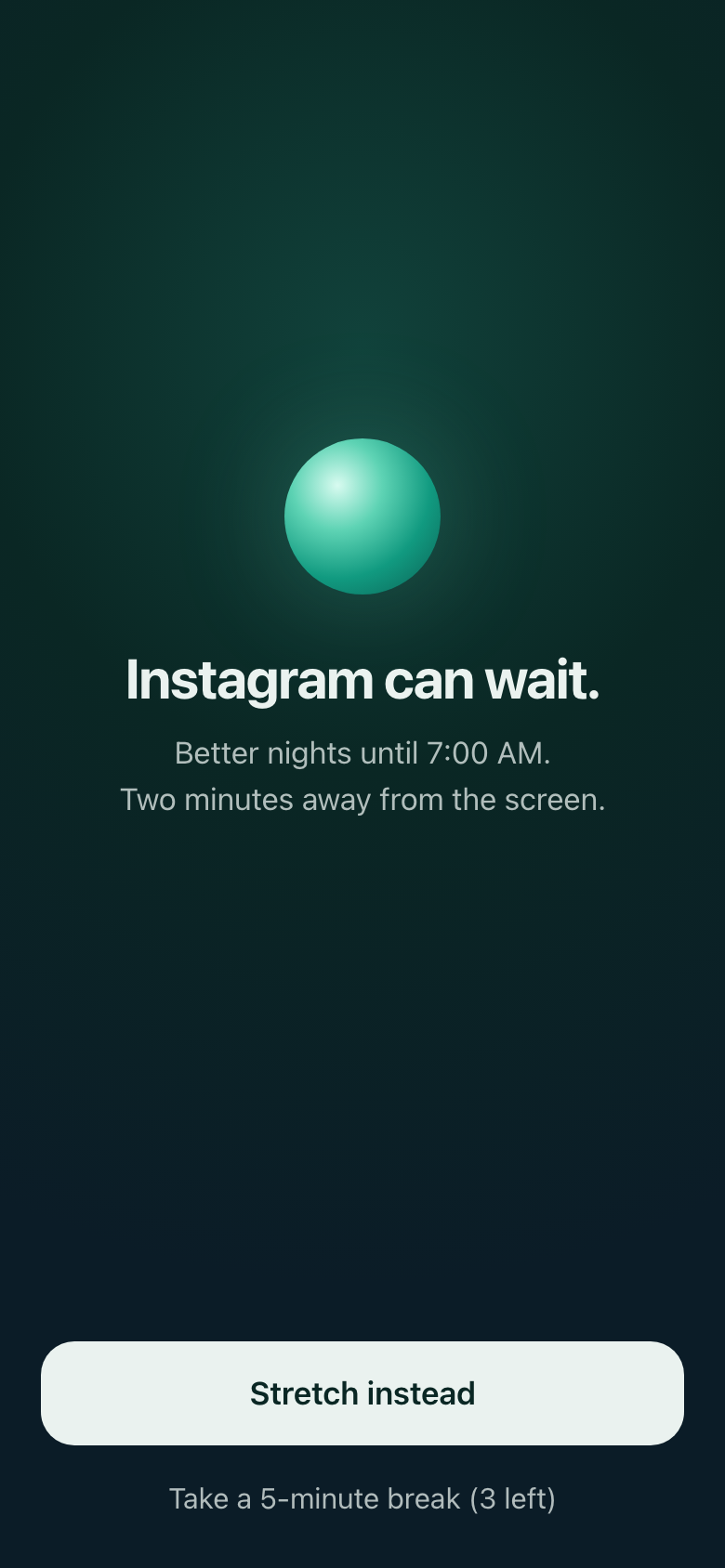
3. The block screen: an instead, not just a no
Today 19% of block screens end in a break. A/B test: "I'll hold" vs a button with something to do instead.
Charge after a proven week, never before: the users who can pay are the ones Lull has already protected.
Who can pay
~1 in 6 installs is still protected in week 2. Asking for money before the first held block would scare people off at the step everything depends on.
What the market does
The top earners use a hard paywall at the end of onboarding. It is their top complaint: 70% of Unrot's and 67% of BePresent's bad reviews.
The offer, built
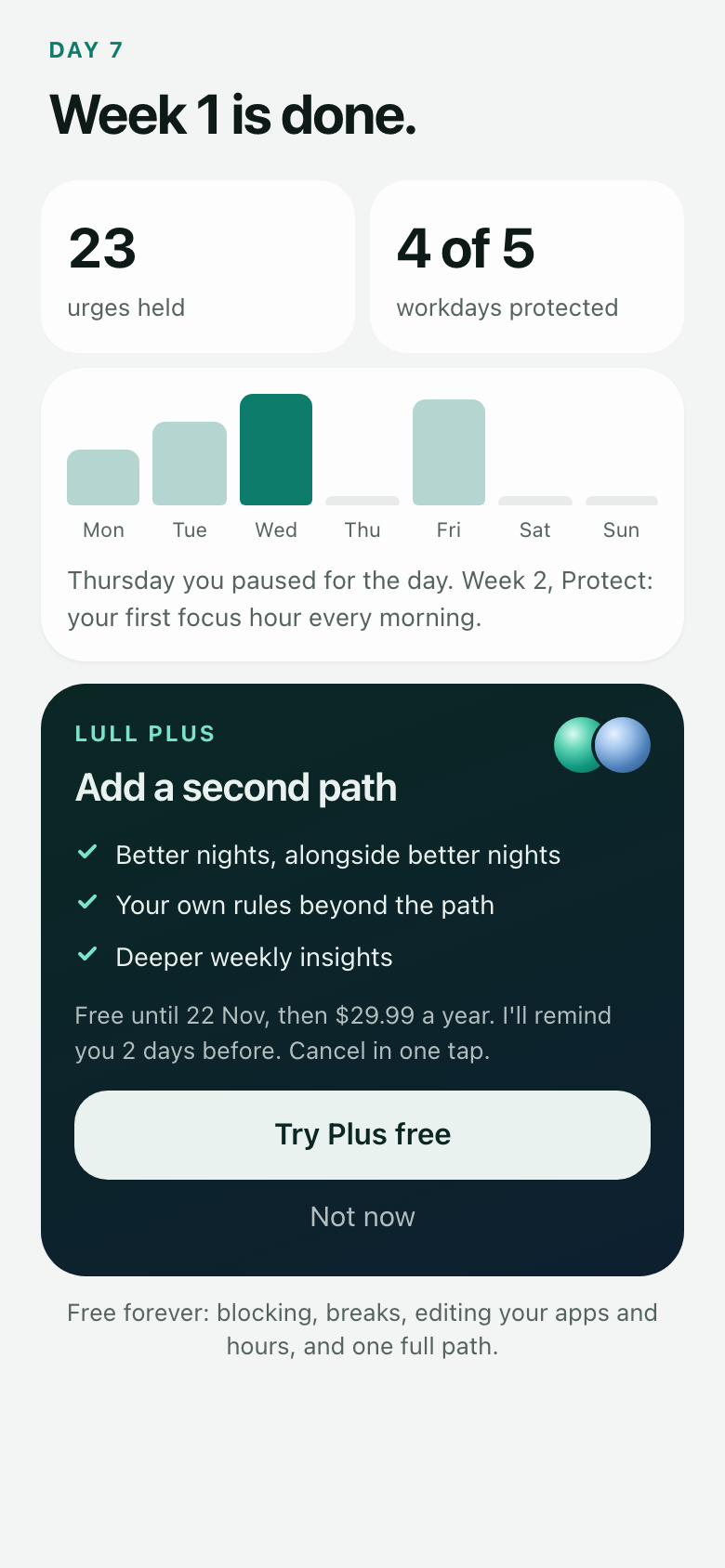
Lull Plus: a second path (e.g. better nights alongside deep work), your own rules beyond the path, deeper weekly insights. 7 days free, then $29.99 a year, a reminder 2 days before.
Free forever
Blocking, breaks, editing apps and hours, strict mode and one full path. Never charge for the protection itself. Offered at the week-1 report, never in onboarding.
Four tests, in an order our traffic allows: one onboarding test at a time, others alongside only when they reach different users.
| Test | Primary metric | When |
|---|---|---|
| 1. Path vs today | Held block in 24h (33% today) | First, ~6 weeks |
| 2. Block screen: hold vs instead | Blocks ending in a break (19% today) | In parallel, ~2 weeks |
| 3. After a no: "Not now" vs ask until allowed | Share who allow Screen Time, among those who first said no | After test 1 |
| 4. When to offer Plus | Free trials started per protected user | Step 3 of the plan |
Year 1: four problems, in the order users hit them.
Get people protected on day 1
Problem2 in 3 installs never get a held block.
Build- New onboarding (A/B test)
- Alert if Screen Time access is lost
- Session recordings
Day-1 held block: 33% to 40%+
Keep them through week 1
Problem27% go quiet by day 3; 20% turn blocking off by day 14.
Build- Block-screen A/B test
- Day-3 and day-10 milestones
- Weekly report, widget, emergency unblocks
Fewer quiet by day 3, fewer switched off by day 14
Fit real phone use, start charging
ProblemSocial-media users want limits, not total blocks.
Build- Daily opens limit for social apps
- Strict mode, offered in week 3
- Plus, after a proven week
Social users protected in week 2: 41% to 50%
Grow through friends
ProblemWord of mouth is the only free way to more installs.
Build- One accountability friend
- Do the path together
- Referrals
More installs from word of mouth
Seven steps. AI did the reading and the heavy lifting; I did the trying and the deciding.
- 1I used the prototype myself first, to get a feel for it and what could already be better.Me
- 2AI ran the data analysis and the market research, down to a shortlist of the top apps worth trying.AI
- 3I installed and used those apps myself: their focus, their audience, what they do well and badly.Me
- 4AI looked across my recordings and their reviews for patterns.AI
- 5I had AI take some of the shipped apps apart (static reading only) to see what runs underneath.Both
- 6I picked what to apply: competitor patterns that work (why reinvent the wheel), ideas from other apps, and my own.Me
- 7From all of that I set the direction, and built and tested the prototype with AI.Both
Tools
- Claude Code: SQL on 112k events, review mining, the prototype and this deck. Claude Design for screens.
- OpenASO: App Store keyword rankings and competitor listings (US + GB).
- REA: static teardowns of 4 competitor builds, pulled with Apple Configurator.
- Second opinions from Claude and Gemini. A simulated user panel (8,000 real reviews), labelled: not user research.
Get people protected on day 1, give them a reason to stay, and charge only once Lull has proven itself.
1. Day 1
New onboarding: a goal, a plan, a promise, and a guided ask that Lull repeats after a no.
Activation 33% to 40%+
2. Week 1
One step a day, sourced notes, an instead on the block screen.
Fewer silent by day 3
3. Money after value
Blocking free forever. Plus as a second path, offered after a proven week.
Once protection grows (step 3)
My first two weeks
Build the alert for lost Screen Time access, launch test 1 (new onboarding vs today), and watch how many allow Screen Time and how fast they reach the ask.
The evidence
Metrics detail, sizing, test design, market, iOS limits, checks and other findings.
For a blocker, "opened the app" is the wrong DAU. I measure protected users and keep opens next to it.
Kinds of active day, after install day
23% of the value is invisible to plain DAU. The prototype makes this gap bigger on purpose: a held block closes the app, no timer keeps you in it.
| Role | Metric | Why |
|---|---|---|
| North star | DAU = protected users a held block that day, 7-day average | Counts value delivered, not visits. Averaged over 7 days because most blocks run Mon-Fri. |
| Shown next to it | App opens | Engagement with the app itself; the daily step gives one intentional open a day. |
| Input | Activation: held block in 24h | The gate to everything else. Practice blocks do not count. |
| Guardrails | Break rate per block screen (19%), groups switched off, Screen Time disconnects | Make sure "protected" never rises by annoying people |
Activation is the gate to retention: activated users are 33x more likely to still be protected in week 2.
% with a held block in week 2 (days 7-13)
- Holds in every channel and both app versions: 34-67% vs 0-6%.
- Not just keener users: people who allowed Screen Time but had no held block in 24h were 4% protected on day 7, vs 43% for those who had one.
- Late is still worth it: first block on day 1-6: 31% protected in week 2 (n=29).
- Correlation, not proof. The Fix 1 A/B test proves the lift.
If activation goes from 33% to 42%, week-2 protected users grow by 8‑24%.
Week-2 protected users per 100 installs
- Today: 0.33 x 50% + 0.67 x 1.5% = 17.7.
- +9 pts activation is the target, not a given: it means about 12 more grants per 100 installs, roughly a quarter of the users who now leave or refuse.
- The big unknown: how well the new activators stick. Range from the late activators (31%, CI 17-49%) up to today's activators (50%).
- So the test reads week-2 protected, not just activation.
One bold test, not five small ones: each activation test needs about six weeks of traffic.
A/B test: Path onboarding vs today
- Hypothesis: a plan built from the goal, a promise before the ask, a coached ask and a second ask raise activation from 33% toward 42%.
- Primary: activation (held block in 24h, practice blocks excluded). Fast reads: Screen Time grant rate, seconds to reach the ask.
- Secondary: week-2 protected. Guardrails: break rate, disconnects, day-1 uninstalls, opened-DAU.
- Who: new installs, paid social excluded (20% vs 37% activation, a one-off campaign).
Sample and duration
- ~830 users per arm to detect +20% relative (33% to 40%) at 80% power, 5% significance.
- ~1,660 users in total vs ~1,200 non-paid installs a month: about 6 weeks.
- So: test the bundle first; split the parts later. Use the grant rate as an early read, and first-run sessions with 5 users before launch.
Big demand, young money: 120 million Americans tried to cut back last year, and one app makes $10 million a year.
Demand (US adults)
| Adults 18+ | ~270 M |
| Say they spend too much time on their phone | 53% (70% of 18-29) |
| Tried to cut back in the last 12 months | 45%, about 120 M |
| ...and did not fully succeed | 3 in 4 |
| Of them on iPhone (estimate) | ~65-70 M |
That is Lull's job: helping the attempt stick.
Money
- Opal, the leader: over $10 M a year and over 1 M daily users (founder, Apr 2026). Moving to free-first cut download-to-paid from 20% to 9% and still grew revenue.
- Concentrated: only 2 of 84 apps in top search spots stay on the top-grossing chart.
- Opal top 10 in 17 of 28 keyword lists; Unrot (Jun 2025) grows fastest with "earn your screen time".
- Vendor "category size" reports range $0.5-2.8 B for 2025 by definition. Context only, low confidence.
At today's traffic any paywall is a rounding error. Protected users and installs are worth more than price, so DAU stays first.
Year 1, bottom-up
| Installs | ~1,500 a month (Lull data) |
| Protected in week 2 | ~20 per 100 after Fix 1 |
| Start a Plus trial at the week-1 report | 15% (10-25%), assumption |
| Trial to paid | ~40% (health and fitness median) |
| Price | $29.99 a year |
| Paid per 100 installs | ~1.2 (Opal: 9) |
| Revenue, year 1 | ~$6.7 K ($4-11 K) |
What it means
- Even Opal's 9% would make only ~$50 K on this traffic. Growth in protected users and installs comes first.
- The ceiling: Opal's $10 M at ~$0.36 per install needs ~2.3 M installs a month. Later, Lull needs more value per user too.
Price check
$29.99 sits at the low end: Opal $60-100, Unrot $70, BePresent $100 (family) a year. Fine for launch; test $29.99 vs $49.99 once Plus is live.
Plus offer timing: day 7 vs week 3. Trial starts as the fast read, protected users as the guardrail.
The test
- Hypothesis: offering Plus after a proven week converts better than offering it in onboarding, and costs no protection.
- Variants: offer at the day-7 report vs at the start of week 3. Never in onboarding, never before the first held block.
- Primary: trial starts per protected user. Revenue is too slow to read in a small app.
- Guardrails: week-2 protected, path turned off, opened-DAU.
When and how long
- Starts when Lull begins charging (step 3 of the plan), after the activation tests: the same traffic limit, so in sequence, not in parallel.
- Duration is set from the trial-start baseline once Plus is live; before that there is no rate to size on.
- Decision rule: keep the later offer unless it lowers trial starts and leaves protection flat.
The four tests in full: hypothesis, metric, guardrails, timing.
| Test | Hypothesis | Primary metric | Guardrails | When |
|---|---|---|---|---|
| 1. Path vs today | A goal-built plan, a promise and a coached ask get more installs to a held block | Held block in 24h (33%). Fast read: grant rate, seconds to the ask | Week-2 protected, day-1 uninstalls | First, ~6 weeks |
| 2. Block screen | An instead on the button turns a "no" into a decision | Blocks ending in a break (19%); re-tries in 5 min | Pauses, path turned off | In parallel, after activation, ~2 weeks |
| 3. After a no: "Not now" vs ask until allowed | Asking again until allowed wins back more of the 29% who say no | Share who allow Screen Time in 24h, among those who first said no | Drop-off, uninstalls, App Review | After test 1, or early on grant rate |
| 4. When to offer Plus | An offer after a proven week converts better without hurting protection | Free trials started per protected user | Week-2 protected, path off | Step 3, day 7 vs week 3 |
What I designed around: Apple decides what a blocker can show and when.
No app list, no pre-ticks
Apps cannot list what is installed or pre-tick Apple's picker: each pick is a sealed token only Apple's list can create. So the plan names categories, the picker is coached, and later edits open pre-ticked.
A fixed block screen
Apple's shield is an icon, a title, a subtitle and two buttons, and cannot open Lull. So the instead lives on the button and the win is counted, not shown in a new screen.
No block before permission
Nothing can be blocked until Screen Time is allowed (then Face ID). So: a promise before the ask, a real practice block after. A drawn copy of Apple's dialog is an App Review risk; Opal, ScreenZen and BePresent ship it.
What I assumed, and what would change my mind.
| Assumption | Why | What would change it |
|---|---|---|
| DAU-first at the start | Starting assumption; for a blocker I define active as protected | A target for revenue in year 1 |
| Small team, ~1,200 non-paid installs / month | From the data | More traffic = more, smaller tests |
| Keep the app-blocking focus | The brief | - |
| Activation drives retention | 50% vs 1.5% week 2, holds in every channel | Fix 1 test lifts activation but not week-2 protected |
| Paid social is excluded from tests | 20% vs 37% activation; one-off campaign | A plan to scale paid social |
| Fewer opens is fine | Lull works when it is not opened (23% of protected days) | Protected users fall while opens fall |
How I checked the numbers
- Cohort: users with a full 24h of follow-up (n = 1,502). One rule in every script.
- Every held block has a matching block screen 5 minutes earlier (31,046 / 31,046).
- No events before install or after the data end.
- Retention curve re-run on a fixed cohort (143 users, 21+ days): same shape.
- Confounders: activation gap holds in every channel and both app versions.
- Weekday bias: D7 sits on the install weekday; week 2 used instead.
- Small n flagged with 95% confidence intervals (late activators: 17-49%).
- Retracted: "1.1.0 raised grant rate" (51.5% vs 51.4% on non-paid users, p = 0.62).
Other findings for Q&A
- Paid social test: 20.2% vs 36.9% activation (p < 1e-7); 55% of installs in the 19 Oct week. Its activators also stick less (34% week 2 vs 42-67%).
- "Start a session" without permission: 67 of 67 refused; 1.5% ever grant. A dead end. In the prototype, every blocked action without Screen Time opens Apple's ask instead.
- Weekend dip: protected users -17% at weekends, all from Mon-Fri schedules.
- Most blocked apps: Instagram and TikTok (~4.4k held blocks each), WhatsApp (3.7k), Snapchat, Reddit, Facebook, X, YouTube.
- Breaks: 19% of block screens, flat across apps. Highest for Telegram and Discord (22%).
- Strict mode: 100% of its block screens hold, but only 7% of all block screens.